Tools of the Trade: Drawing

How’s everyone doing? Hangin’ in there? Good. Me too. Home life’s getting stressful, but that’s to be expected with the self-isolation. The kids and I did need to get out, so we went for a jog. Speaking of which, if you ever want to feel old, go jogging with a 5 year old. But for the most part, I spent this weekend attempting to recover physically and emotionally from attempting to work and homeschool full-time simultaneously, so I didn’t touch a pencil. My main take away from all this, so far, is that we weren’t made to live like this.

But hang in there. This won’t be forever.

And now to the point. I’ve already written a post about how I make some of my artwork, so it only follows that I should write a on what I use to make some of my artwork. Since I consider myself more of a drawer than a painter, I’ll start with those tools.
IN-STUDIO TOOLS

I have always tried to keep my tool sets really simple and stripped down. A great deal of the creativity of art comes from the restraints you’re under (whether self-imposed or imposed by others/circumstance), not to mention, we’re just drawing here. No reason to get wasteful of cash and space. Find what works for you, and stick to that.

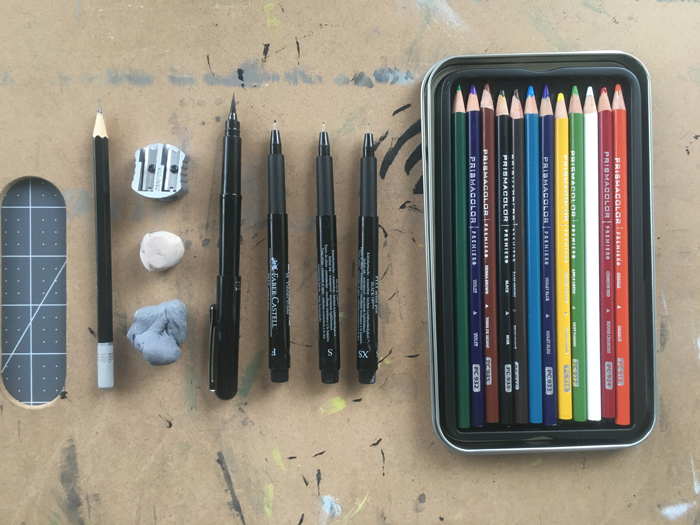
The tools that I use in my studio (or as my kids like to call it, the “dinner table”) are as follows:

  • HB Pencil. For the vast majority of my work, this is the only pencil that I use. I know a lot of artists like to use colored pencil to sketch in, but I grew up using a No. 2 for everything, and this is the closest pencil to that that has the least amount of smudging and smearing, which is important to me, as the flat of my hand has a tendancy of getting all over the place.
  • Pencil Sharpener. Because X-acto knives are for cutting paper and board to size. You’re not impressing anyone.
  • Hard white eraser. For me, this is the most successful tool for removing pencil lines, without discoloring the paper. You do, however, need to be mindful of whether there is any ink residue on there (after you’ve used it after you’ve inked a drawing), because that will smear on the paper if you’re not careful. So just keep a scrap of paper on the side where you can rub that off.
  • Kneaded eraser. This one’s great for just knocking some pencil work back rather than fully removing it, or for lightening a section of colored pencil for highlights. It’s also an absolute must if you’re working with charcoal.
  • Pens. This is the most important set of tools for drawing in my opinion. Every pen has it’s strengths and weaknesses, and which one’s you use will help to shape your style.
  • My workhorse is the Pentel Pocketbrush brush pen. It’s a super solid brush, is fairly easy to control while giving expression to your line work, takes replaceable ink cartridges, and I can get it at Michaels. The ink is waterproof, as long as you don’t try to drown it and give it enought time to set, so I’m able to use it with watercolors and markers. It’s awesome. I use the technical pens to suppliment the brush pen, and the brand I use for finished work is Faber-Castell, not because they’re the best (I actually like Microns better), but because their ink’s blackness most closely matches the Pocketbrush. I use an F for contour lines for inorganic props (like machinery) and sets, and S and XS for fine details and hatching (the XS specifically for hair).
  • The final drawing instruments that I use are Prismacolor pencils. In keeping in line with pairing things down and keeping the setup simple, I’m only working with the standard 12 pack now, and I mix my colors on paper. They also come in handy for adding detail, texture, and shading to watercolor or marker base colors.
  • Drawing boards. I’ve got a portable one that I can clamp paper to and work flat on the table or on my knee on the couch (pictured here), and a larger adjustable-tilt board. I only use the latter for drawings that will take multiple hours or days, because the tilted surface saves stress on my back. But if that will then need to get inked, I’ll switch it to the portable board, because I only like to ink flat.
  • You may have noticed something missing, and that’s a ruler. I only use rulers as a straight edge to assist me in cutting paper down to size, because I firmly believe that an artist shouldn’t need a ruler after they’ve gotten past high school art.

TRAVEL TOOLS

I also keep a separate, smaller set of tools bagged up if I ever want to sketch outside of the house. When doing so, I grab one of a handful of sketchbooks laying around and take these:
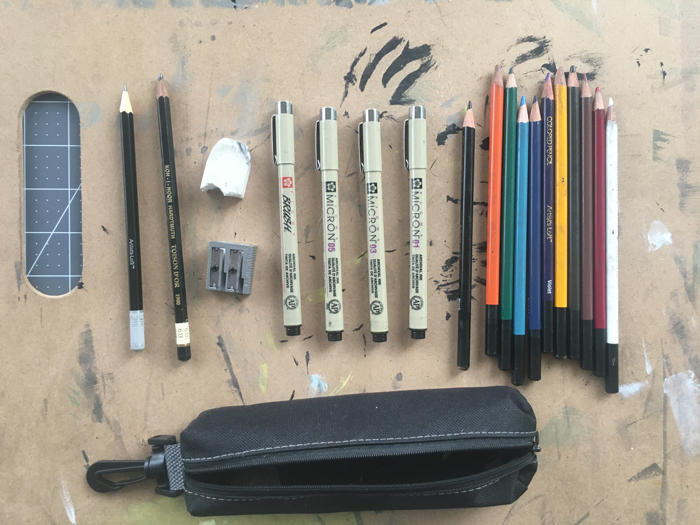
  • HB pencil. Still the main deal.
  • 6B pencil. In case I want to top keep it just a pencil drawing, I’ve got this softer option to add value.
  • Hard white eraser
  • Pencil sharpener
  • Picma Micron pens. I’ve added their brushpen to the .05, .03, and .01. It’s not great, but the ink’s the same color, and anything I make with these tools I consider a sketch, so it gets the job done.
  • Artist’s Loft colored pencils. These are the generic brand offered at Michaels. I have much larger set if I want to do more intense coloring in my sketchbook. But for the most part, this travel set does the job just fine.

PAPER

Right now, I’m loving working with Canson’s Bristol and Mix Media papers. I use the Bristol for pencil only (including colored pencil) work, or drawings where traditional means end after inking, and the coloring/painting will be done digitally after scanning. I use the Mix Media paper when I think there may even be the possibility that I’ll want to add watercolor after inking. This is the paper that I’m using for all of my Inktober 52 animal drawings. But why 14×17 pads? Because I can easily cut it down to 11×17 or 11×14, which are standard frame sizes, which also just feel the most comfortable for me to draw on.

WRAPPING UP

That’s it. That’s all that I need to make some good drawinings. You don’t need a lot, and you can get everything you need (or at least what I need) at Michaels, and you know you’re going to get all of it at 40% off or better.

PROJECT UPDATE

  • To do my part in bringing a little creativity and fun into these troubled days, I’ve collected a bunch of my Solving Problems (still need a better title…) ink drawings into a print ready PDF so that kids (or you!) can print it off at home and use as coloring pages. You can download it for free here. Have fun!
Ink and Watercolor Process

Well, that escalated quickly. Since my last post a week ago, I took my vacation to relax and work on artwork. Let’s just say that didn’t quite go how I planned. Yes, I got a lot of work done, but not everything I wanted (more on that at the end), and my relaxation started to go out the window as the Coronavirus went full pandemic on us. So now I’m looking at at least two weeks coming up of remote work for the day job, and at least the first week of them will be with the kids staying home, as their school has “extended Spring Break for another week.” Basically, my work/life balance will be severely tested (as I’m sure many of yours will), but I’ll take that over having to turn into the dad in a post-apocolyptic movie any day (I’m looking at you, Cormac). So, everyone, stay smart and safe, but don’t shut your lives down. I, for one, am going to be keeping our life as normal as possible, and I’m going to keep creating artwork and putting it out into the world, because if it can make at least one other person smile right now, it’s worth it.

This blog was originally going to be about the tools I use for each of my work processes, but that would take more prep-work that was available to me as the world caught fire, so today I’m going to break down my process for creating ink and watercolor paintings. This is my favorite way to work right now because it combines what I’m best at (drawing) with the wet medium that I’m most comfortable with (watercolors). Let’s start, shall we?

… we have to start, because I’m writing this…

Step 1: Rough Sketch

I need to make a confession: I don’t always do this step. Heck, I usually don’t do thumbnails either. I know that’s going to upset a lot of art teachers, but it’s true. Even some art teachers who I respect a lot say you should do 50 thumbnails before you move to sketches. And maybe that works for some people. My response would be, if you need to do 50 different options of a drawing, you haven’t thought about it enough yet. You jumped onto the pencil or stylus prematurely. Also, if someone can give me proof that they picked a thumbnail that wasn’t one of the first 12 they sketched, I’ll go vegan for a week. For me, I won’t do more than 3 thumbnails of a design, and I won’t do more than 2 rough sketches. I think that’s because a) I spend a lot of time thinking about a piece before I draw it (seriously, sometimes a year before I get around to some of these things), b) I went to film school, so I naturally think in terms of camera angle, staging, the rule of thirds, and dividing lines, c) and I’ve been drawing since before I could talk. Usually, when I do a rough sketch, it’s so I can tell myself I “worked” on a piece without actually working on it. It’s basically just productive procrastination, and I have a sneaky suspicion that it is for most other people with long, drawn out sketch processes.

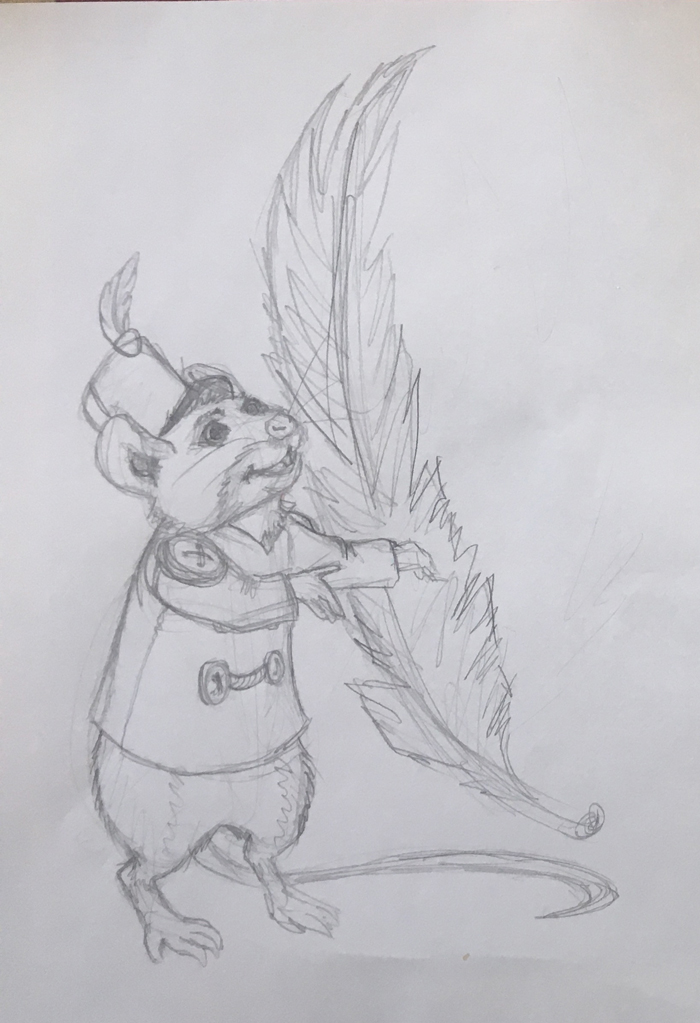
I DID do a rough sketch of “Little White Lie” though because I had to come up with a painting in a couple days for a gallery show. This one took a couple minutes (please don’t ever spend more time than that; there’s so much else to do in life), and that’s less time than I just spent explaining why thumbnailing is usually a waste of time.

Step 2: Pencils

At this point, I grab the watercolor paper or board, an HB pencil, and get to work. Since watercolor is a transparent paint, I’ve gotta work really light at this stage because mistakes will show through. I have to remind myself of this the whole time, because I naturally press really hard with my pencil, and I think that’s because I hold my pencil weird. I hold it with my index, middle, and ring fingertips and thumb touching the pencil at all times, so there’s more muscles and articulation involved than normal. I’d like to take this moment to thank whatever teacher it was that didn’t attempt to correct me on this technique when learning to write. Whoever you are, you just might be responsible for my style, ability, and career.

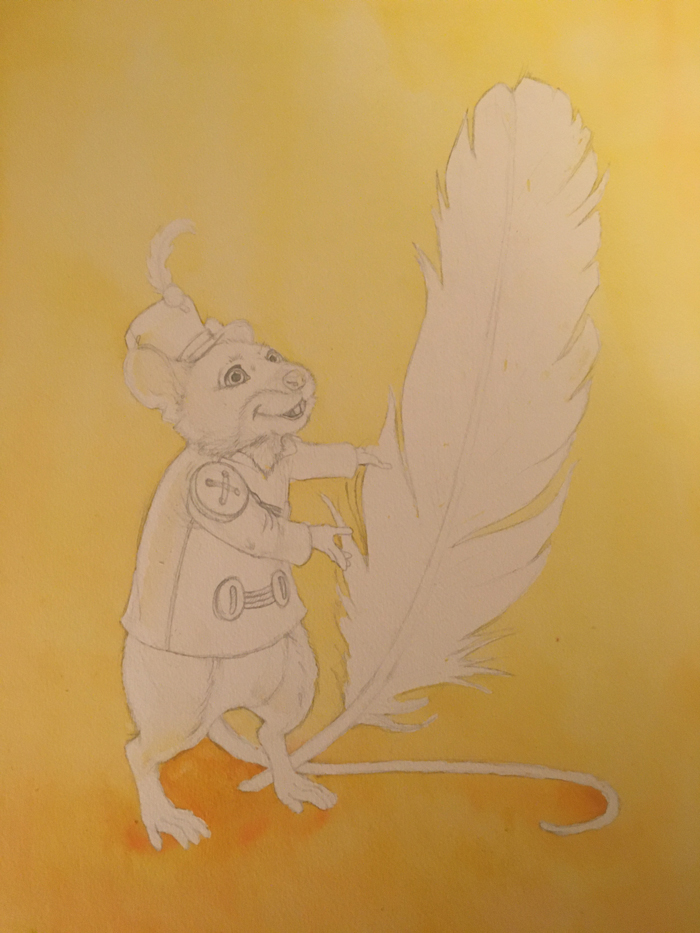
Since I’ll be eventually going over this in ink, I try to only stick to the outlines of shapes and forms, but I usually add more detail, like the hair directions, to serve as a guide when I get the pen out. You’ll also notice that between the rough sketch and the final sketch, I reconsidered the shape, direction, and placement of the feather to improve the overall sense of balance. Also to make it suck less, but that’s just a gut thing, I guess.

Step 3: Masking Fluid

This is another step that doesn’t always happen, but this time it’s entirely dependent on what the painting needs. Since I knew that the background was going to be a wash, I needed to block off the subjects. Since I’m not made of money (sorry, Michaels) I only traced Timothy instead of filling him all in.

Step 4: Wash

Once the masking agent has dried, I grab the biggest, softest brush I have, water down the background, and throw a watercolor wash on there. I’m not the best at this, and am still learning to trust the paint the first time, instead of overworking it, which always causes problems (oversaturating the paper, muddying the colors, etc.). Once the wash has dried, I rub the mask off. For those of you that loved peeling dried Elmer’s glue off your fingers in elementary school, you will find this step very fulfilling. You can see that the wash bled onto Timothy a bit. I wiped if off as best as I could, but didn’t sweat it, since I knew I was going to be covering it with stronger, darker colors.

Step 5: Inking

This is the step where the real drawing is done. I do the heaving lifting with the Pentel Pocketbrush, and finer detailing with Faber-Castell Pitt pens. At this point, style happens, and I can still go off script and fix things in the drawing (like his left hand, which I changed to hold the feather, because the original position didn’t make sense in perspective).

Step 6: Paint

Then, you just kind do everything. Again, since watercolor is transparent, you work light colors to dark, which allows for the first area you painted to be dry by the time you’re done with the last area of the same base color, so you can move right into adding value and detail. Once all the values and watercolor details are in place, I grab the smallest pen I have (an XS tip), and go through and add super fine detail where I want it (whiskers, string thread). The last step is to add white highlights (beyond what’s just bare paper) with white ink.

And that’s it! You’ve got an ink and watercolor painting.

PROJECT UPDATES

  • I finished my first set of Adventure Time Flat Pops and will promote them the next time they have a sale over at TeePublic.
  • I’ve compiled the first 9 Inktober 52 drawings into a coloring book! Here’s the flip through of the mockup:
  • I scanned six of my watercolor paintings and replaced their images on this website. The colors are richer and actually resemble the physical paintings (hurray!). I’m hoping to have prints available through Society6 by Wednesday.
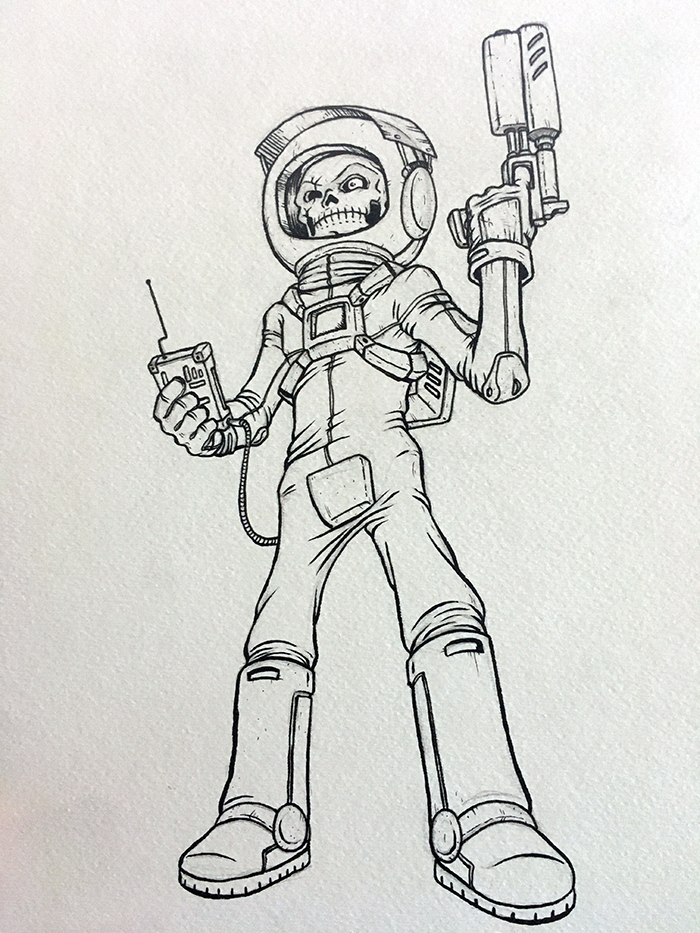
  • Now I gotta fry some chicken and paint this guy (in that order):